
 (C:)
(C:) profile
 AgentProvenance
Agent provenance · Visual analytics · Research system
AgentProvenance / AgentTrails
AgentTrails turns raw agent trajectories into interactive provenance graphs, helping people understand what an agent did, compare alternative executions, and extract patterns worth reusing.
Why provenance?
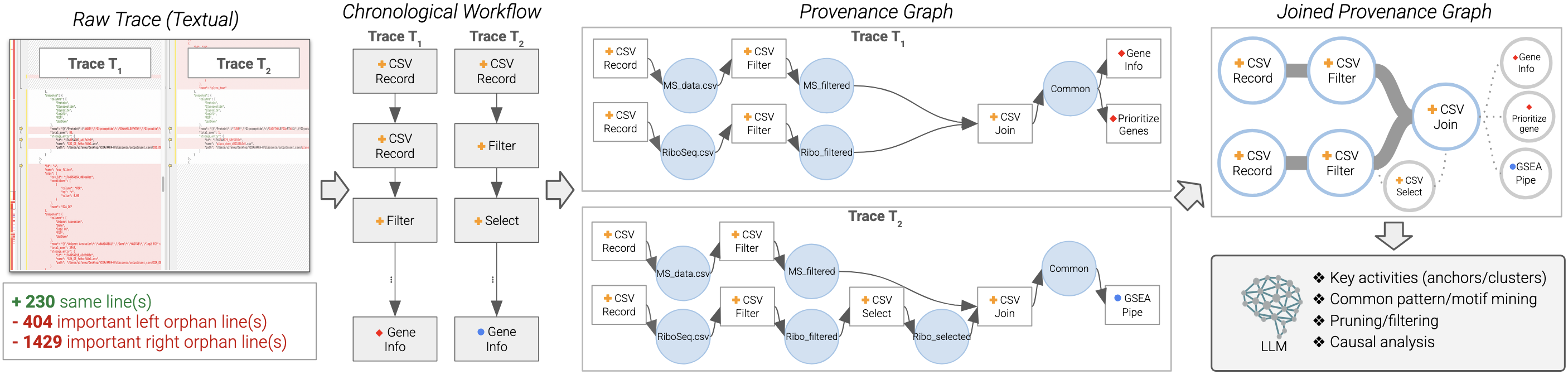
Agentic systems can complete complex tasks, but their execution histories are often long, fragmented, and difficult to audit. A final answer alone does not explain which tools were used, how intermediate artifacts were transformed, or why two runs reached different outcomes. Provenance makes that process visible.
How AgentTrails works
- Transforms tool calls into actions and their inputs and outputs into artifacts.
- Recovers producer-consumer dependencies using trace evidence such as artifact identifiers, paths, filenames, URLs, and reused semantic values.
- Joins multiple executions into a quotient graph for structural comparison.
- Uses activity capsules to align related steps while preserving divergent branches.
- Supports pattern extraction, downstream analysis, and reusable skill abstraction.
Coordinated visual analysis
The overview uses an UpSet-style matrix to compare tool usage across selected traces. From there, users can inspect a single reconstructed graph or move to the joined graph, where node size communicates activity support, edge width shows dependency support, and color preserves trace membership. Filtering helps separate dominant workflows from anomalies and low-support behavior.
React system and provenance backend
The current system uses a React frontend for trace input, comparison, and interactive provenance visualization. A separate Python API backend owns PROV graph construction, evidence-based candidate edges, graph caching, and optional LLM refinement and chat.
The compact graph representation keeps activities, entities, and dependency evidence distinct. Raw calls are sanitized before refinement, and suggested relationships remain auditable rather than being silently promoted to ground truth. The frontend and backend run as separate services, keeping visualization concerns independent from provenance reconstruction and model calls.
All rights reserved 