
 (C:)
(C:) profile
 AgentProvenance
Data discovery · Semantic retrieval · Research system
MosaicJoin: Compact Semantic Sketches for Value-Level Join Discovery
MosaicJoin represents columns with small but expressive semantic sketches, making value-level join discovery faster without requiring model training or fine-tuning.
The problem
Value-level join discovery compares the contents of columns rather than relying only on names or schemas. This can uncover semantically related data, but direct comparisons become expensive when query columns and data-lake columns contain many values.
Compact semantic sketches
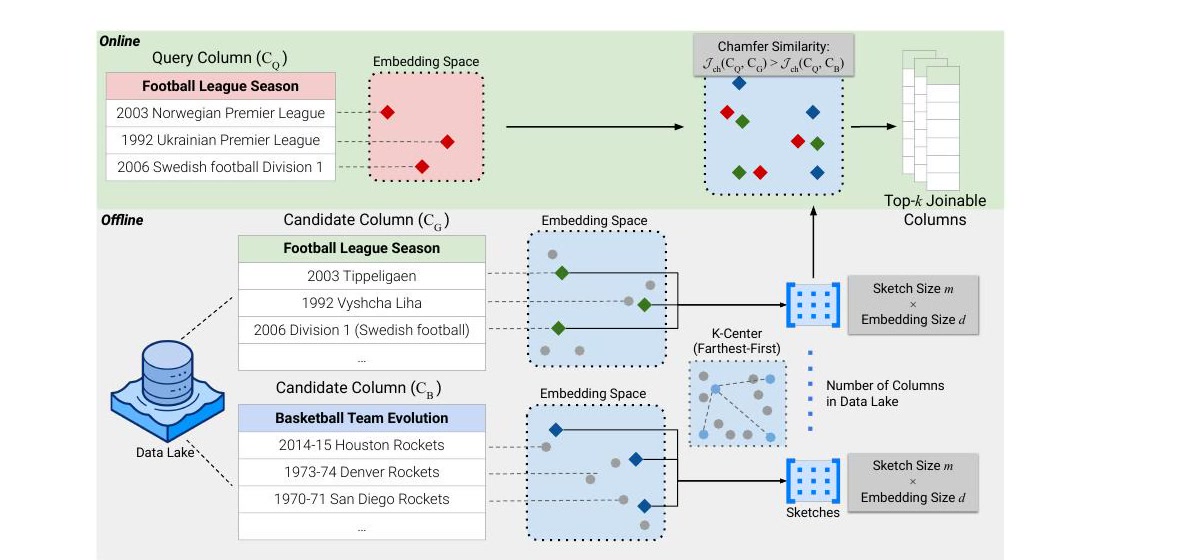
MosaicJoin embeds the values in each data-lake column, then selects a fixed number of representatives with a farthest-first k-center procedure. The result is a semantic sketch that covers the column’s embedding space while preserving rare but join-critical values.
Represent individual column values in a shared semantic space.
Select k representatives that cover each data-lake column.
Rank candidates with a Chamfer-style value-level similarity score.
Efficient online search
At query time, MosaicJoin can subsample large query columns and score each candidate sketch at a cost bounded by sketch size rather than full column cardinality. The repository supports multiple embedding models, sketch-selection methods, Chamfer variants, and retrieval metrics for reproducing the evaluation.
Why it matters
The approach makes semantic join discovery practical at scales where exhaustive value comparison is prohibitive, while remaining training-free and adaptable to heterogeneous data. The evaluation spans AutoFJ, Freyja, WT, and WDC-augmented search spaces and reports HITS, precision, recall, NDCG, and MRR.
All rights reserved 